Guayaquil’s City Hall | Neoclassical Architecture at the City’s Core

Guayaquil's City Hall.

Guayaquil’s City Hall

Explore Guayaquil's City Hall. A witness to the growth and changes that the city has undergone.

Words & Photos: Trail Forth Journal

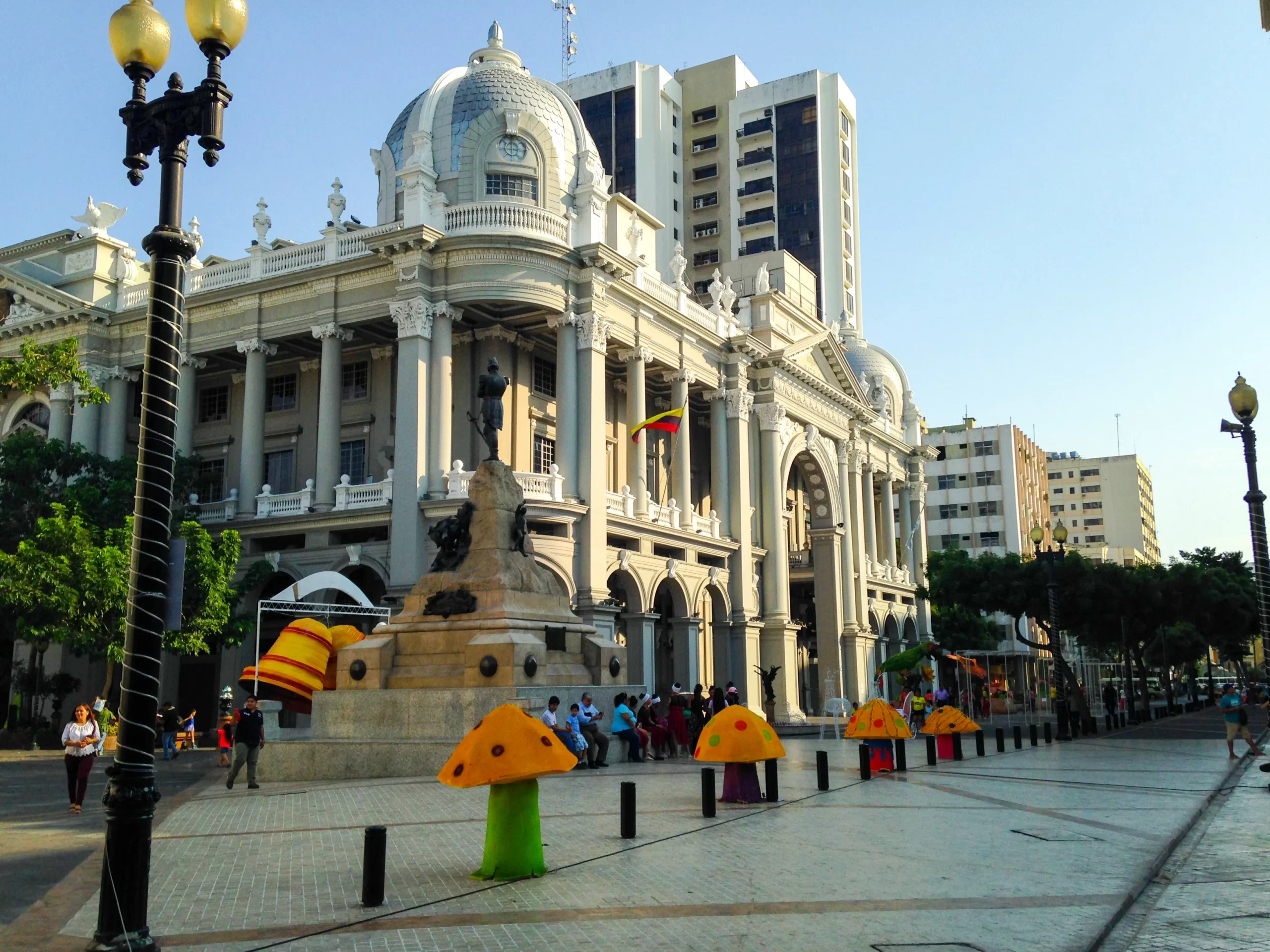
The Town Hall, formerly known as the Municipal Council, is one of the city’s most iconic buildings. Designed by architect Francesco Maccaferri, the Guayaquil Town Hall is one of his most notable works in the city.

History of the Guayaquil City Hall.

In the 18th century, it was located where it is today. However, it was then moved to the site of the current Parque Seminario. The Town Hall was built in its current location on the Malecón and 10 de Agosto Street in 1817. The Declaration of Independence of Guayaquil was signed on this site on 9 October 1820. In 1908, the wooden and brick building was burnt down when it was discovered that rodents inhabiting the underground part of the building had caused the bubonic plague that had afflicted the city. Consequently, the seat of the city administration was relocated to the building that is now the Club de la Unión, on the corner of 10 de Agosto and Chile streets.

The Italian influence in Guayaquil's City Hall.

The final cost of the construction of the City Palace was 2′ 305 000 sucres, a very high sum for the time. The building is in the modern Renaissance style, with a mixture of Doric and Gothic art from the 1920s, and is one of the last buildings to be influenced by Italian architects. The inner passage is modelled on the Galleria Vittorio Emanuele di Milano. Its design has strong neoclassical features, inspired by 19th century architecture. The purpose of taking a business centre as a reference was due to the fact that the Cabildo had as a fixed income the rental of premises and offices of other institutions on its ground floor. For this reason, it was also called Palacio Municipal de Comercio (Commercial City Hall.).

The façade is decorated with several Latin phrases, bas-reliefs and columns. The dome is iconic, as are the jars and allegorical figures in the upper triangle of the north façade, created by the Italian sculptor Emilio Soro.

Guayaquil’s City Hall

Location map: Guayaquil's City Hall

The characteristic Eduardo Arosemena passageway connects Malecón Avenue with Pichincha Street. It is named after the first president of the Municipal Charity Board of Guayaquil. The Municipal Palace underwent a restoration process in 1994 during the administration of León Febres-Cordero.

In 1921, the town council decided to give the public clock its own spot on the seafront, at the beginning of Avenida 10 de Agosto. However, this did not last long; five years later, the clock collapsed under its own weight due to construction errors that had been detected over time. Consequently, in 1927, the decision was made to demolish the building and store the English clock.

Guayaquil's City Hall 360°

Guayaquil’s City Hall.

Guayaquil's
City Hall.

Heritage Architecture
at night

Guayaquil's
City Hall.

Architecture
Heritage
Interior

Guayaquil's City Hall.

GUAYAQUIL

Trail Forth Journal

Jairo Cabrera Ecuador

Jairo Cabrera

Editor · Travel Routes & Experiences Curator

“Trail Forth Journal is an independent editorial project dedicated to documenting maps, places, routes, and experiences across Ecuador, seen through a local lens.”

If this guide helped you plan your trip, feel free to write to me with any questions about your visit. You can also support the project.

How can I help you?

Tell me about your dates, accommodation, or transportation questions so I can help you plan better.

This support is voluntary. It helps sustain this independent publishing project.

QR Deuna
QR Zelle

Contribution Policy

Contributions are voluntary. They are also non-refundable. These contributions help support the documentation work of Trail Forth Journal.

Share

Read this next

Go Further

error: Content is protected !!